Skip to product information
1 of 5
Customer Rating
Rated 4.8/5 by 1500+ Customers!

Plaims - Dial Knee Sleeve

Plaims - Dial Knee Sleeve

One dial you can turn at the top of the descent. 90 Days to send it back.

Features List
Check Icon
Two clicks tighter at the top of the descent. Gloves on, standing up.
Check Icon
No hinge to dig in over an eight-hour day on the hill.
Check Icon
7.2 ounces. 204 grams. Sits under hiking trousers.

Product Description

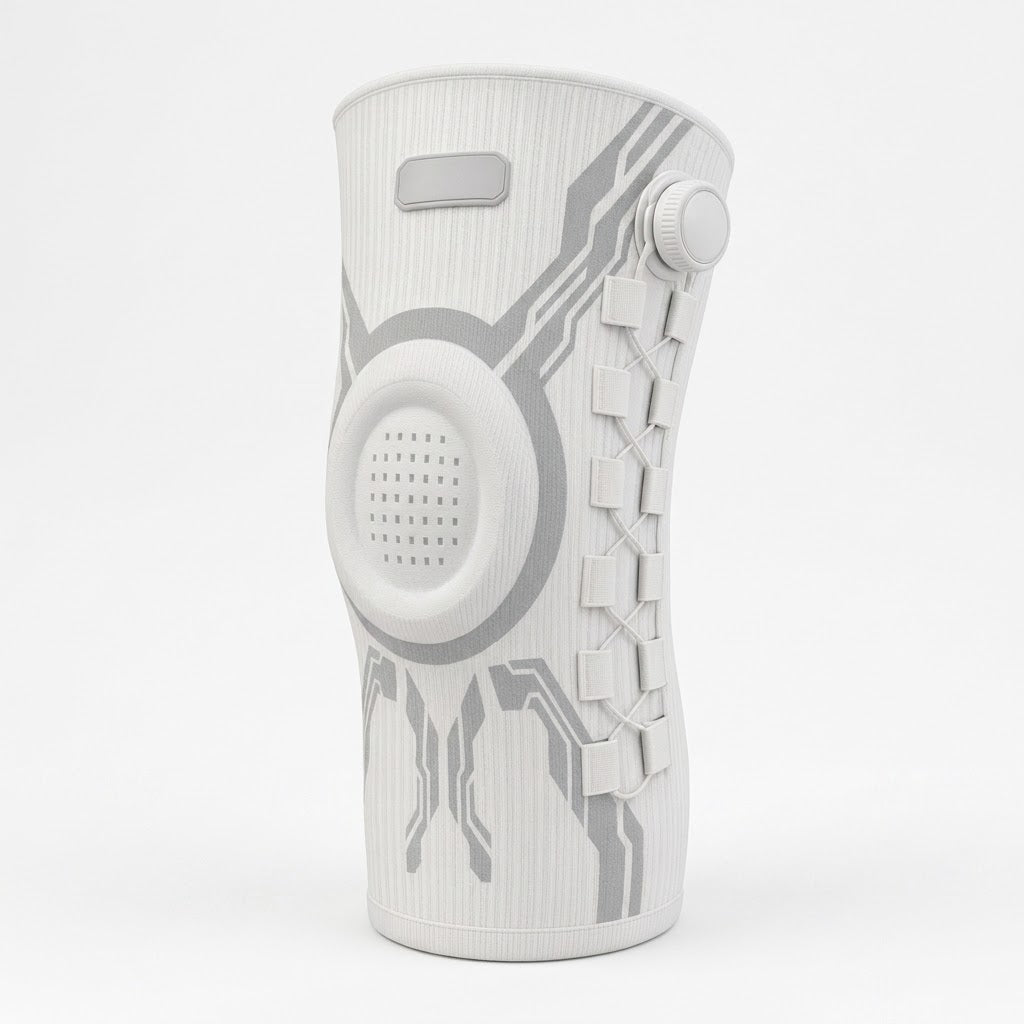
Plaims - Dial Knee Sleeve built around one idea: the support you need changes during a hike, so the support should change too.

A dial on the outer side pulls a six-loop lace ladder underneath it. Turn it clockwise and the whole ladder draws in evenly, so the hold tightens across the joint instead of pinching in one spot. Pull the dial out and the lace releases in one go.

Loose on the climb, so nothing fights your stride and nothing cooks your leg going up. Firm before the descent, when the load through the knee is at its worst. Backed off at camp. No hinge, no straps, one coiled stay down the side, 7.2 ounces on your leg.

Set for the ground you are on, not the ground you were on an hour ago.

How to Wear it?

Put it on at the trailhead, before anything hurts. Dial backed all the way out, kneecap pad centred, then turn clockwise until it feels held rather than squeezed.

Leave it there for the climb. Two clicks tighter at the top, before you start down, not two miles into the descent when you are already short-stepping.

Back it off on the flat. Off at camp and off in the car. It is a tool for the parts of the walk that punish you, not something to live in.

Our guarantee

90 Days. Take it on a real walk with a real descent, not round the block. If it is not doing the job, send it back for your money.

View full details

Nobody quits hiking. They just stop booking it.

It goes one decision at a time. You pick the loop with the gentler way down. You let the group go ahead on the steep bit. You take the same photo from the same summit and spend the whole descent thinking about the car park.

Then a weekend comes up and you look at the profile, see the long drop off the back, and find a reason not to go.

The climb was never the problem. You can still do the climb.

One dial. Four parts that do the work.
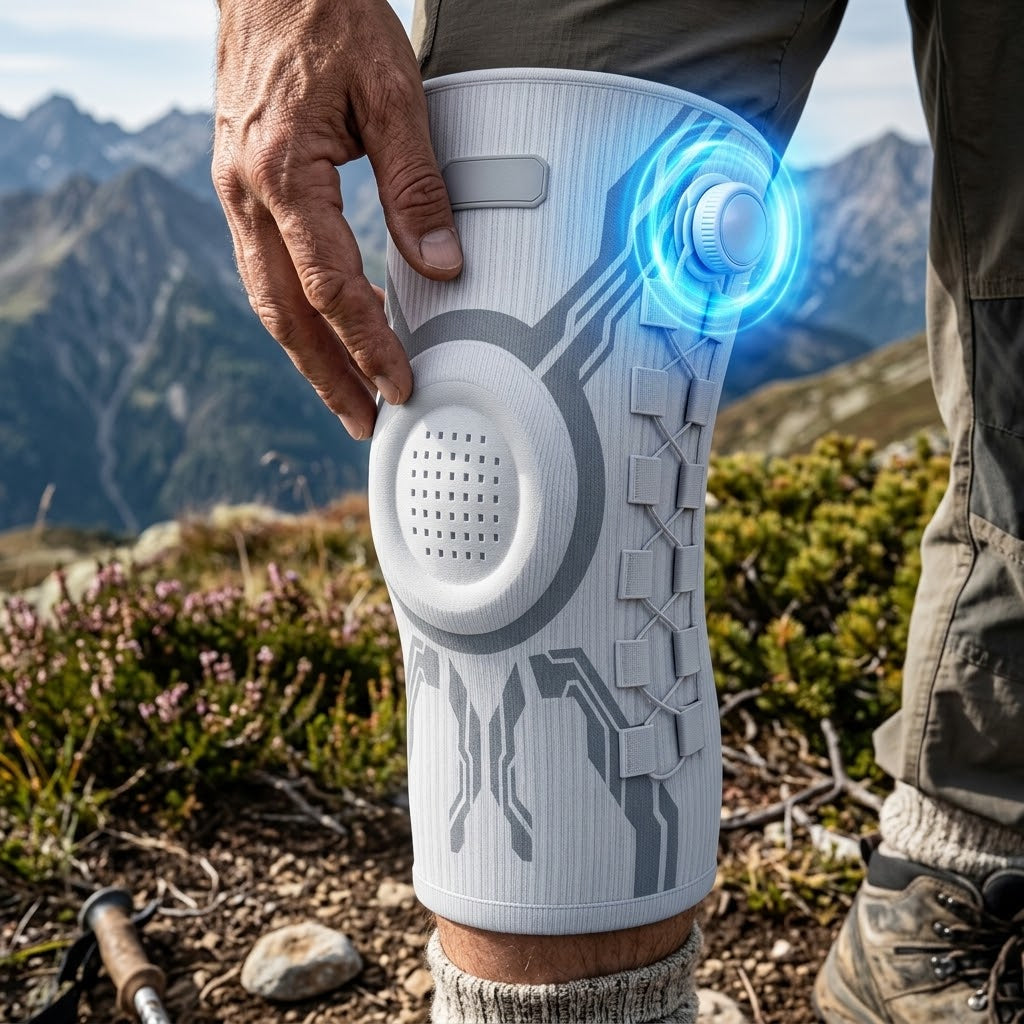
Micro-adjust dial

Micro-adjust dial

Change the tension mid-activity, without taking it off.
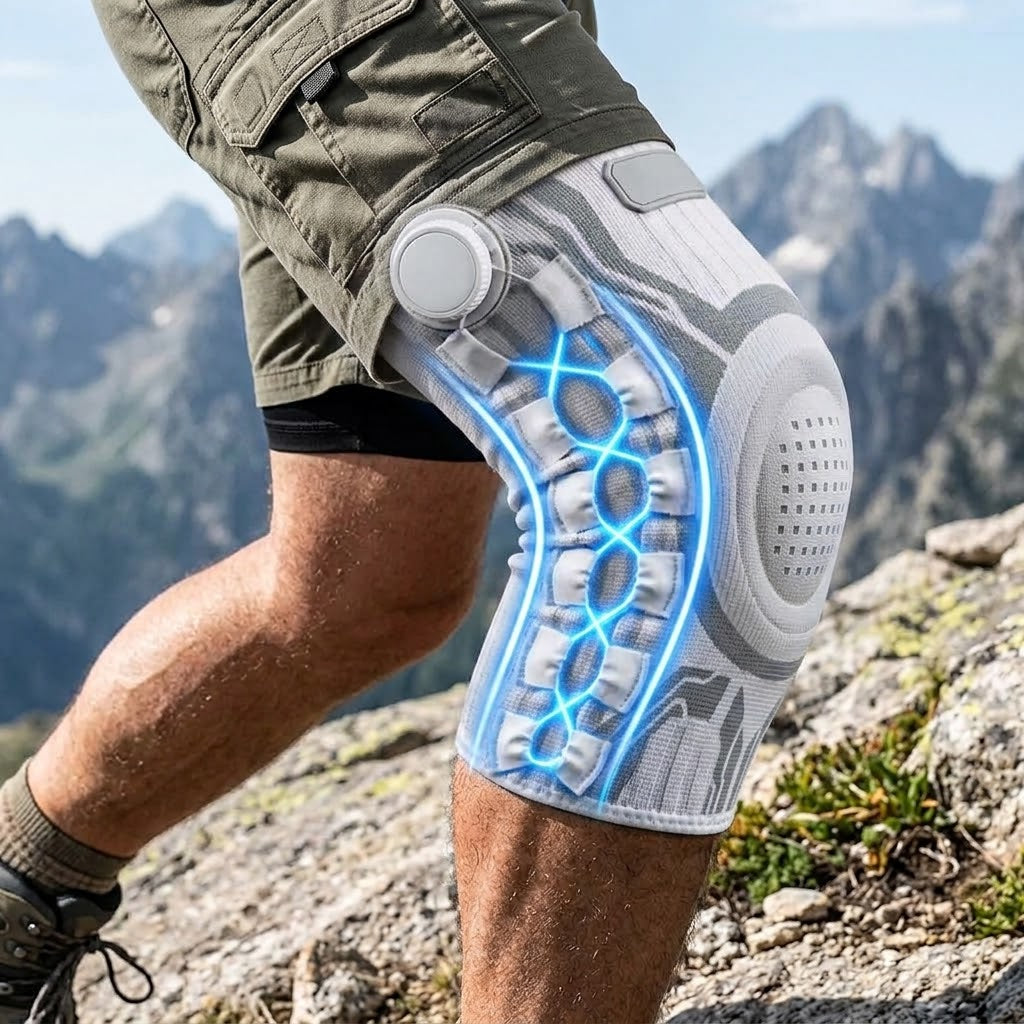
Six-loop lace ladder

Six-loop lace ladder

Spreads the pull evenly down the whole joint.
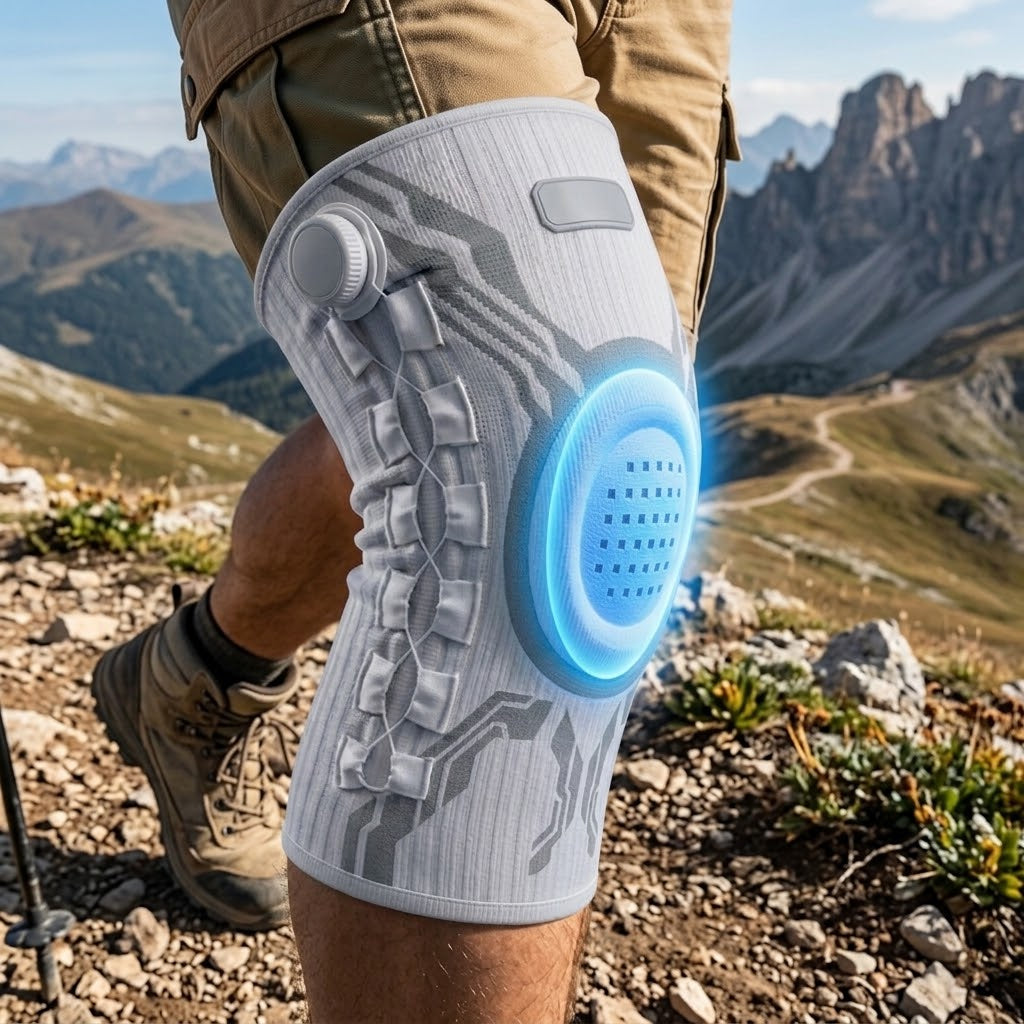
Patella pad and ring

Patella pad and ring

Cushions the kneecap. The silicone ring lifts out.

Coiled side stay

Coiled side stay

Steadies the knee sideways, with no hinge.

Fine going up. Limping on the way down.

Going up, your legs work like brakes are never needed. Going down, every step is your knee catching your bodyweight plus the pack, over and over, for hours. That is why the flat feels fine and the smallest descent does not.

Now look at what you are wearing. A sleeve is pulled on in the car park and holds exactly that setting all day. Set it for the climb and it does nothing when the trail tips down. Set it for the descent and you carry that tension up two thousand feet first.

The support was never wrong. It was fixed.

Loose for the climb. Tight before the descent.

Car park: on before you set off, set so it feels held rather than squeezed. Nothing to think about for the next two hours.

At the top, before you start down: two clicks tighter. It takes about two seconds, standing up, with gloves on and both poles still in your hands.

Back on the flat, or at camp: back it off. Off in the car on the way home.

What Our Customers Say

5 out of 5 stars
Pack Out Without the Hobble
Last season I cut a trip short because the descent cooked my knee. This time I dialed it in before the rocky stretch and loosened it on the flats. Still sore after — I’m not twenty — but I walked out under my own power instead of limping the last two miles.
Dana, 57
5 out of 5 stars
Closet Brace, Open Trail
I used to dread the way down more than the climb. Soft sleeves rolled by the second mile; the heavy brace lived in my closet. This one I dial tighter for the steep stuff and ease off when my knee swells. Finished the loop without hobbling to the car.
Elena, 61
5 out of 5 stars
Tighten at the Summit
Poles help. They don’t stop my knee from shaking on switchbacks. I put this on at the summit, twist it in for the descent, and forget about yanking a sleeve up every ten minutes. Not a miracle — just the down doesn’t ruin the day anymore.
Chris, 48

90 Days, and we would rather you used them

Take it out on a real walk before you decide anything. A proper descent, a pack on, the kind of day that usually ends with ice and a promise to look at it later.

If it has not earned its place after that, or by day 90, send it back and we return your money.

FAQ

Every sleeve I have owned slid down. Why is this different?

A sleeve holds position by squeezing, so once you have sweated into it and put a few thousand steps through it, it starts travelling down your calf. This holds by lace tension you set yourself. When it does start to feel loose, you turn the dial instead of stopping on a slope to haul it back up with both poles in one hand.

Will grit, mud or rain jam the dial?

The dial sits high on the outer side of the knee, clear of the ground and clear of the lace path underneath it. Rinse it under a tap after a wet or muddy day and let it dry before it goes in the pack. If it ever feels gritty, release the lace and work the dial back and forth a few turns to clear it.

I already use poles. Do I need this too?

Poles take load off the joint and this steadies the joint itself, so they do different jobs. Nothing here asks you to give up your poles, and if poles alone are getting you down comfortably, you probably do not need us.

Does it fit under hiking trousers?

There is no hinge and there are no straps, so the only raised parts are the dial and the oval kneecap pad. Under hiking trousers or anything with a normal cut it sits out of the way. Under a slim trouser you will see the shape of the dial, and you can reach the dial through the fabric to adjust it either way.

How do I choose a size?

Measure around the middle of your kneecap with your leg straight and relaxed, then match that to the size options above. The lace ladder covers a good range inside each size, which is what makes it forgiving when the knee is more swollen at the end of a long day than it was at the start. Between two sizes, order either and use the 90 days to swap it.

I tried a hinged brace and it was torture. Will this be the same?

That is usually the side hinge pressing into the soft tissue either side of the joint hour after hour. This has no hinge. A single coiled stay runs down the outer side to steady the knee, and the hold comes from lace tension spread across six loops rather than from a rigid frame. It is 7.2 ounces, so it is also not the thing tiring your leg out by mile eight.

Should I wear it the whole walk?

Wear it, but not at one setting. Loose on the climb and the flat, firm for the descent and anything steep and loose underfoot. Take it off at camp and take it off in the car. It is there for the parts of the day that punish the knee, not the whole of it.

What if it does not work for me?

You have 90 days to find out, and we would rather you spent them on actual trails. If it has not earned its place, send it back and we return your money.